
Form I-539: Extend Stay or Change Status in the U.S.
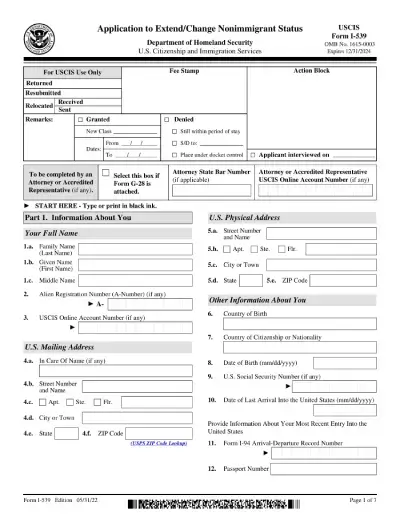
Form I-539 is one of the most important USCIS forms for people who are already in the United States and need more time in their current nonimmigrant status or need to change to a different nonimmigrant category. In most cases, applicants are working against a real deadline: their current stay is ending, their plans have changed, or they need to protect lawful status while another process moves forward.
The official USCIS page for Form I-539, Application to Extend/Change Nonimmigrant Status should always be your starting point. Filing rules, addresses, and accepted use cases can change. This guide explains the strategy behind the form, the situations it generally covers, and the mistakes that most often create denials, rejections, or status problems.
What Form I-539 is for
USCIS uses Form I-539 for several different requests. The form is commonly used by certain nonimmigrants who want to extend their current stay or change to another nonimmigrant status while remaining in the United States. USCIS also uses it in other limited contexts, including some student reinstatement and dependent-related filings.
That broad description is exactly why I-539 content often becomes messy online. Many articles mix together visitor extensions, student changes of status, dependent filings, and special exceptions into one generic explanation. The safer approach is to understand your exact filing goal first, then confirm that I-539 is the correct form for that goal.
Common situations where Form I-539 appears
- A visitor wants to request more time in B-1 or B-2 status.
- A person in one nonimmigrant category wants to request a change to another eligible nonimmigrant category.
- A dependent family member needs an extension or status-related request tied to the principal applicant’s status.
- An F or M student has a reinstatement issue that USCIS instructs them to handle through I-539.
If your case is specifically about B visitor status, you should also review our B-1/B-2 status change page, which goes deeper into visitor-specific extension and change issues.
Who should not use Form I-539
This is where many applicants make expensive mistakes. USCIS makes clear that some classifications cannot use Form I-539 at all, and some employment-based status requests must be filed on Form I-129 instead.
USCIS specifically warns that I-539 is not the correct vehicle for many employment-based classifications, including principal H, L, O, P, Q, R, and TN applicants, among others. USCIS also states that some statuses cannot extend or change through I-539, including categories such as C, D, K-1, K-2, S, transit without visa, and Visa Waiver Program admissions.
If you entered under the Visa Waiver Program or through ESTA, you should be particularly careful. That admission path is not interchangeable with B-2, and it does not create the same extension or change-of-status options.
When to file Form I-539
Timing is one of the biggest practical issues in any I-539 case. USCIS says you should file before your current period of authorized stay expires and suggests filing at least 45 days before the expiration date when possible. The key reference point is usually your I-94 validity period, not the printed visa expiration in your passport.
If you file after your authorized stay expires, you are no longer in a normal, clean filing posture. Late filing may still be excused in limited circumstances, but that usually requires a documented explanation and does not carry the same stability as filing on time.
What USCIS usually expects in a strong I-539 filing
A strong I-539 package is not just the form itself. USCIS wants the request to make factual sense. The supporting documents should show that you were admitted lawfully, that you remained compliant with your status, and that your requested extension or change fits the facts of your case.
- A copy of your passport identity page and admission records, including Form I-94.
- Evidence of your current nonimmigrant status.
- A clear explanation letter describing why you need the extension or change.
- Financial evidence, when relevant, showing you can support yourself during the requested period.
- Case-specific documents tied to the new status or extension request.
Your passport should also remain valid for the period you are requesting. USCIS calls this out directly on the official I-539 page.
How the filing process usually works
1. Confirm that I-539 is the correct form
Do not start with the assumption that I-539 is right just because you are in the United States and want more time. First confirm your category and your intended new category. The USCIS page and the I-539 instructions are the controlling sources.
2. Confirm whether you can file online
USCIS maintains a separate page on I-539 online filing eligibility. Some applicants can file online, while others need to file by mail or use a different process. The online option can be convenient, but the convenience matters only if your case type actually qualifies.
3. Build the logic of your case before you file
USCIS officers are not just checking boxes. They are evaluating whether your request is credible, timely, and legally consistent. If you are extending B-2 because you need more time for tourism or a family matter, the explanation should match that reality. If you are changing to student status, the school timeline and program documents should support the request.
4. File before your current status expires
This is often the single most important strategic step. Filing on time preserves a much cleaner case posture and avoids unnecessary arguments about lateness.
5. Monitor for USCIS notices and requests for evidence
After filing, USCIS may issue a receipt notice, biometrics-related instructions if applicable, or a request for evidence. Missing a response deadline can hurt the case even if the original filing was strong.
Common Form I-539 mistakes
- Using the wrong form when the case actually belongs on I-129 or another USCIS process.
- Filing after the I-94 expiration date without a strong explanation.
- Requesting a new status that does not match the evidence in the package.
- Failing to explain how living expenses will be covered during the requested stay.
- Assuming that a pending I-539 gives permission to work or study when the underlying rules do not allow that activity.
If you are deciding between this guide and a narrower B visitor resource
This article explains the form itself and the general I-539 process. If your question is specifically about B visitor timing or extension strategy, the more targeted companion page is B-1/B-2 status change and extension. If you want the raw form resource, there is also the Form I-539 download page.
Best next steps before filing
- Check your I-94 expiration date and calculate your filing timeline immediately.
- Verify on the official USCIS page that I-539 is the correct form for your category.
- Confirm whether you qualify for online filing or need to file another way.
- Prepare a short, fact-based explanation of why you need the extension or change.
- Review all supporting evidence for consistency before submitting anything.
Official USCIS resources
For live rules and current filing information, use the official I-539 page, the USCIS extension of stay page, and the I-539 online filing eligibility page. USCIS can change accepted filing pathways, addresses, and form usage rules over time, so always verify there before filing.
FAQ
What is Form I-539 used for?
Form I-539 is used by certain nonimmigrants to request an extension of stay, a change to another nonimmigrant status, or, in some cases, related benefits such as F or M reinstatement.
When should I file Form I-539?
USCIS says applicants should file before their current period of authorized stay expires. USCIS also suggests filing at least 45 days before expiration when possible.
Can every nonimmigrant use Form I-539?
No. Some categories are ineligible, and many employment-based nonimmigrant classifications must use Form I-129 instead of Form I-539. Applicants should verify the correct form on the USCIS I-539 page before filing.
Comments