

USCIS Processing Times (2026): How to Check Them and What They Really Mean
If you are waiting for a green card, work permit, travel document, or naturalization decision, one of the first questions you will ask is simple: How long will USCIS take? The challenge is that USCIS processing times are easy to find but often misunderstood. If you also need to track a live update on your own case, start with our guide to tracking your USCIS application status.
This guide explains how to check USCIS processing times correctly, how to interpret the number you see, why cases move at different speeds, and when it makes sense to contact USCIS.
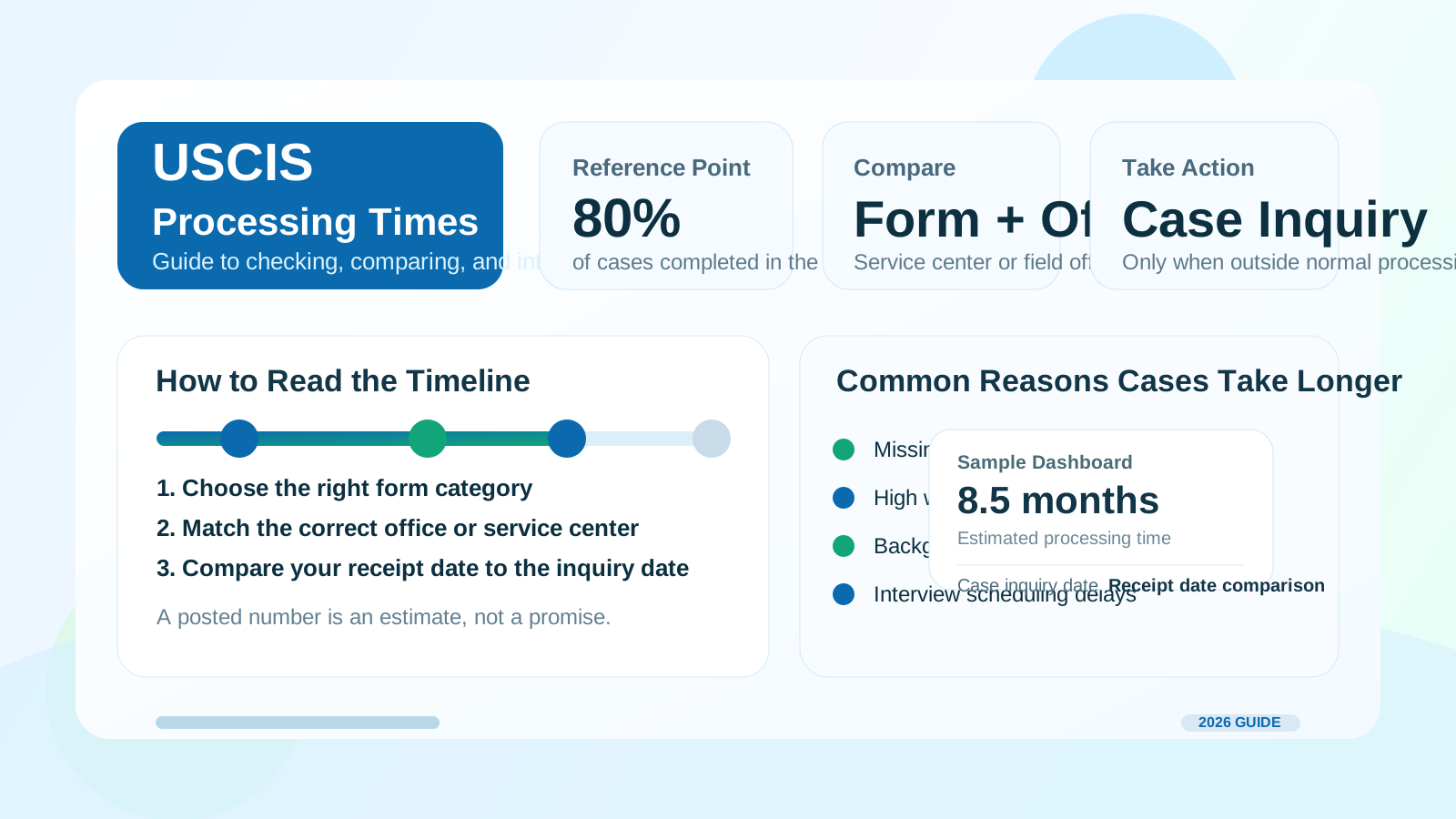
As of May 14, 2026, the best source for current case timing remains the official USCIS tools and notices. USCIS itself says processing times should be used as a reference point, not as a guarantee for any individual case.
What are USCIS processing times?
USCIS processing times are estimates showing how long the agency is taking to complete a particular type of case. These timelines vary by:
- Form type
- Form category
- Field office or service center
- Case complexity
- Background and security checks
- Overall agency workload
In practice, that means two people who file similar forms may still see different results.
Why this topic matters in 2026
Search demand for USCIS timelines is high because applicants want current answers, not historical averages from years ago. Competing immigration sites have recently published fresh 2026 guides on this topic, which is a strong sign that users are actively searching for updated timing information right now.
At the same time, USCIS continues to remind the public that posted times are only estimates. That is why the most useful article is not just a list of months. It is a guide that teaches readers how to interpret the numbers correctly.
How to check USCIS processing times step by step
Use the official USCIS processing time tool and follow these steps carefully:
- Open the USCIS processing time tool.
- Select your form.
- Choose the correct form category.
- Select the field office or service center shown for that case type.
- Review the estimated processing time and the case inquiry date, when available.
Why form category matters
A single form may have multiple categories. For example, a family-based adjustment case and an employment-based adjustment case may not move on the same schedule, even if both use Form I-485.
If you pick the wrong category, the result may be irrelevant to your case.
Why office location matters
Some case types are tied to a field office, while others are tied to a service center. This distinction matters because local workload can change processing times significantly.
What USCIS processing times really mean
One of the most important official explanations from USCIS is that many posted processing times now reflect the time in which 80% of cases were completed, based on data from the previous six months.
That means:
- The number is based on recently completed cases
- It is not a promise for your exact case
- Some cases finish faster
- Some cases take longer
USCIS has also said publicly that processing times are meant to be used as a reference point rather than an absolute measure.
USCIS processing times vs. case status
These are related but different tools.
| Tool | What it tells you | Best use |
|---|---|---|
| USCIS Processing Times | Typical timeframe for similar cases | Estimate how long a case may take |
| USCIS Case Status Online | Update on your specific receipt number | Track real-time movement in your case |
| USCIS Online Account | Notices, uploads, messages, case actions | Manage and monitor your case directly |
If your case status has not changed recently, that does not automatically mean something is wrong. Many cases remain quiet for long stretches before the next update. If you are not sure how to read the identifiers in your file, see our articles on the USCIS receipt number and the USCIS online account ID number.
What affects processing times the most?
Several factors can push a case above or below the posted estimate.
1. The office handling your case
Different offices have different staffing levels, backlogs, and workflow patterns.
2. Completeness of the filing
If USCIS issues a Request for Evidence, the case often slows down because the review clock becomes more complicated in practice.
3. Background and security checks
Some cases need additional review before a decision can be made.
4. Interview scheduling
Cases that require interviews can depend on local appointment capacity.
5. Policy or operational changes
USCIS may change internal allocation, office assignments, or workload sharing. That can shift timelines even when applicants filed around the same date.
Common forms and what to compare
When checking USCIS timing, compare only the version of the case that matches your situation.
| Form | What it usually covers | Important comparison point |
|---|---|---|
| Form I-130 | Family petition | Relationship category and service center handling |
| Form I-485 | Adjustment of status | Family-based vs. employment-based and office assignment |
| Form I-765 | Work permit | Eligibility category |
| Form I-131 | Travel document | Type of travel benefit requested |
| Form N-400 | Naturalization | Field office location |
| Form I-90 | Green card renewal or replacement | Correct form category |
This is one of the biggest places applicants make mistakes. They compare their case to a different form category and assume their case is delayed when it may not be.
For deeper form-specific reading, you can also review:
- Guide to Form I-130: Understanding the Petition for Alien Relative
- Understanding Form I-485: Your Guide to Adjustment of Status
- Form N-400 | Application for Naturalization
- Guide to Renewing or Replacing Your Green Card
How to know if your case is outside normal processing time
USCIS offers an official path for cases that appear delayed. In general, you should first compare your receipt date to the case inquiry date or follow the instructions USCIS provides for your form and office.
Use this simple checklist:
- Confirm you selected the correct form
- Confirm you selected the correct category
- Confirm you selected the correct field office or service center
- Compare your receipt date against the inquiry guidance
- Review your USCIS notices and online account for missed requests or appointments
If your case is truly outside normal processing time, USCIS may allow you to submit a service request.
When not to panic
It is normal for applicants to worry when online forums show faster approvals than theirs. However, one fast approval from another person does not prove your case is delayed.
Usually, you should avoid panic if:
- Your case is still within the posted range
- USCIS recently sent a receipt notice, biometrics notice, or interview notice
- Your case has unusual facts that may naturally require more review
- The agency has not yet reached the inquiry threshold for your form and office
If your pending case is adjustment-related, our page on timeline and steps after filing Form I-485 can help you understand what often happens next.
When to follow up with USCIS
You should consider follow-up when one or more of these are true:
- Your case is officially outside normal processing time
- You missed or never received an important notice
- USCIS requested evidence and you already responded long ago
- Your address changed and you suspect mail delivery problems
- Your case status shows something unusual that does not match your notices
Best follow-up options
- USCIS online account
- Case status tool
- Outside normal processing time inquiry
- USCIS Contact Center
Mistakes people make when checking processing times
These errors lead to bad assumptions and unnecessary anxiety:
- Comparing a family-based case to an employment-based case
- Using a different office than the one relevant to the case
- Treating the posted estimate as a guarantee
- Ignoring a Request for Evidence or interview notice
- Assuming silence always means a problem
- Comparing only to social media anecdotes
Practical example
Imagine two applicants both filed Form N-400 in the same month.
- Applicant A is assigned to a faster field office and has no travel complications
- Applicant B is assigned to a busier field office and has a more complex travel history
Even though both used the same form, their cases may move at noticeably different speeds.
That is why a USCIS processing time should be read as a benchmark, not a promise.
Quick reference: what each USCIS timing signal means
| Signal | Meaning | What you should do |
|---|---|---|
| Estimated processing time | Benchmark based on completed cases | Use it for planning, not certainty |
| Case inquiry date | Point at which follow-up may be appropriate | Compare against your receipt date |
| No recent case status update | Your case has not changed publicly yet | Keep monitoring your account and notices |
| Request for Evidence | USCIS needs more information | Respond fully and on time |
| Interview notice | Case is moving to the next stage | Prepare documents and attend as scheduled |
Recommended YouTube resource
USCIS publishes customer-focused videos and online account walkthroughs on its official YouTube channel. If you want visual guidance in addition to this article, start here:
SEO summary for readers
If you searched for USCIS processing times 2026, how long USCIS takes, or how to check USCIS case processing times, here is the short answer:
- Use the official USCIS processing time tool
- Choose the exact form, category, and office
- Treat the number as a reference point
- Compare your case to the inquiry date before escalating
- Use your USCIS online account and case status tools together
You may also find these related pages useful:
- Tracking Your USCIS Application Status
- Understanding USCIS Form I-797: Notice of Action
- The Essentials of USCIS Receipt Numbers: What They Are and Where to Find Them
- How Can You Verify the Status of Your USCIS Case Online?
Final thoughts
The best way to use USCIS processing times is not to ask whether the number is perfect. It is to use the number correctly. If you match the right form, the right category, and the right office, you will get a useful benchmark. From there, you can decide whether to keep waiting, prepare for the next step, or submit an inquiry.
For applicants in 2026, the real advantage is not just knowing the latest number. It is understanding what that number actually means.
Sources
- USCIS processing time explanation and transparency updates
- USCIS on the 80% completion method
- USCIS glossary definition of processing times
- USCIS tools for pending cases
- USCIS video and photo gallery with official YouTube reference
Videos
FAQ
What do USCIS processing times actually measure?
USCIS processing times are estimates based on how long it took the agency to complete a large share of similar cases during a recent period. They are a reference point, not a guarantee for any individual case.
Are USCIS processing times the same as case status?
No. Case status tells you what is happening in your specific case. Processing time tells you the typical timeframe for similar cases at a particular office or service center.
Why do two applicants with the same form have different wait times?
Wait times can differ because of office workload, security checks, missing evidence, interview scheduling, and differences in the facts of each case.
When can I submit an outside normal processing time inquiry?
Generally, you should wait until your case is beyond the USCIS case inquiry date or otherwise marked as outside normal processing time for your form and office.
Comments